
A JMC Digital product
Ryvato — a full project-management engine, governed by strategy.
Most organisations can write a strategy and most can run a project. The expensive gap is between them. Ryvato closes it from the engine up: CPM scheduling, Gantt and the critical path, earned-value analytics, risk and portfolio health — with objectives, key results and KPIs cascading down onto the same projects.
What it is
Five functions, one integrated system
Ryvato — a JMC Digital product.
- 01
Five functions, one integrated system.
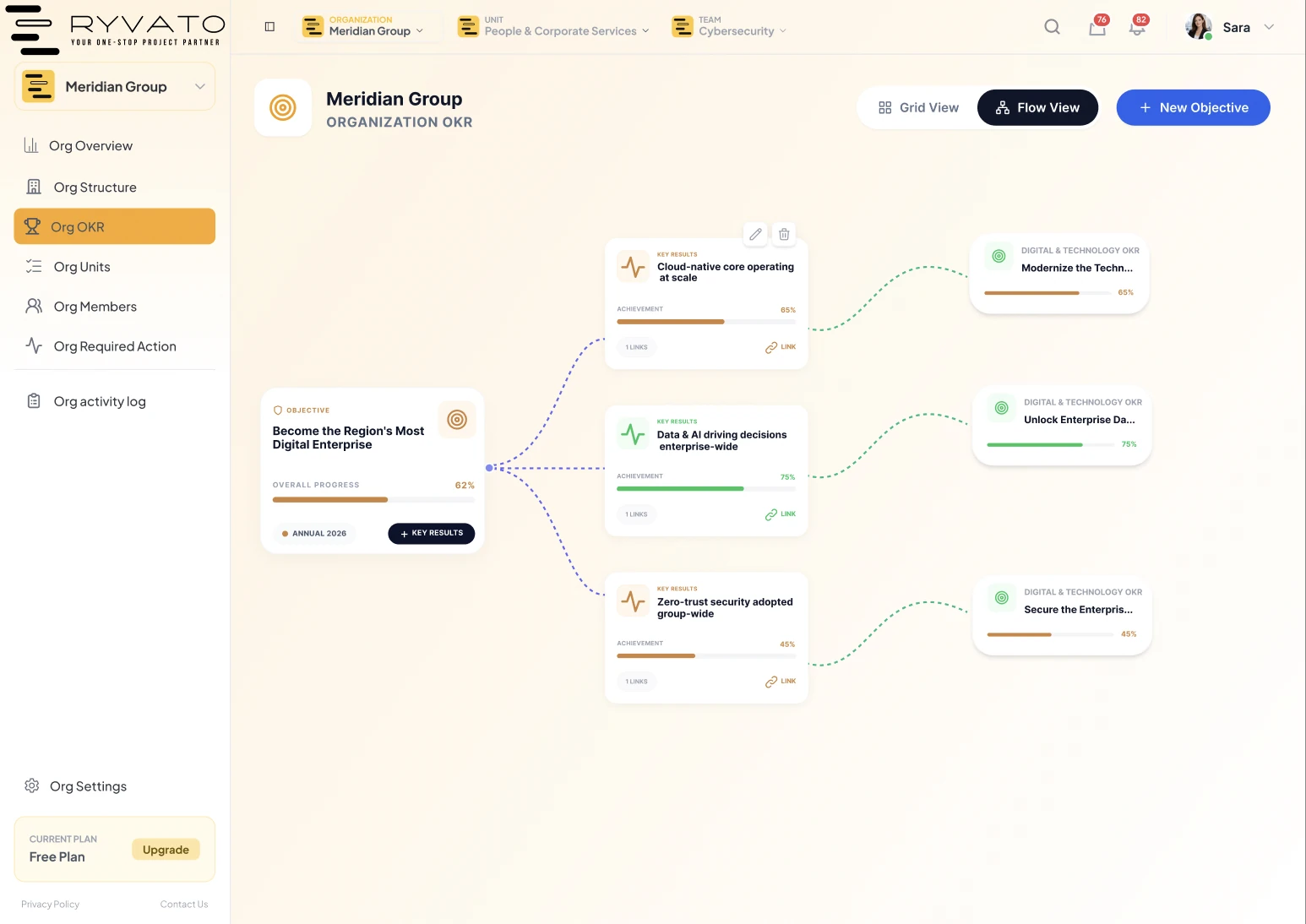
Strategy and objectives cascade down through the organisation. Beneath them, full project management: every project scheduled on the critical path, tracked on earned value, its schedule and cost performance rolling back up. Health scoring turns a portfolio into a single number a board can act on, and risk surfaces make the things going wrong visible while they are still cheap to fix.
- 02
Built on nine international standards
— including PMI's PMBOK, ANSI/EIA-748 for earned value, ISO 21500 and ISO 31000 — because governance that is not standards-based is just an opinion with a dashboard.
- 03
KPIs, connected.
Build the KPIs an organisation actually steers by, and connect each one to the projects, teams and units that move it — and upward to the organisation’s OKRs, so a number on a dashboard always traces to the work behind it.
- 04
Bilingual by design.
Arabic and English throughout, including board-ready reporting in both.
- 05
Proven at scale.
Ryvato runs in production today across the Kingdom — inside large organisations, with hundreds of projects and dozens of teams in daily use.
The argument
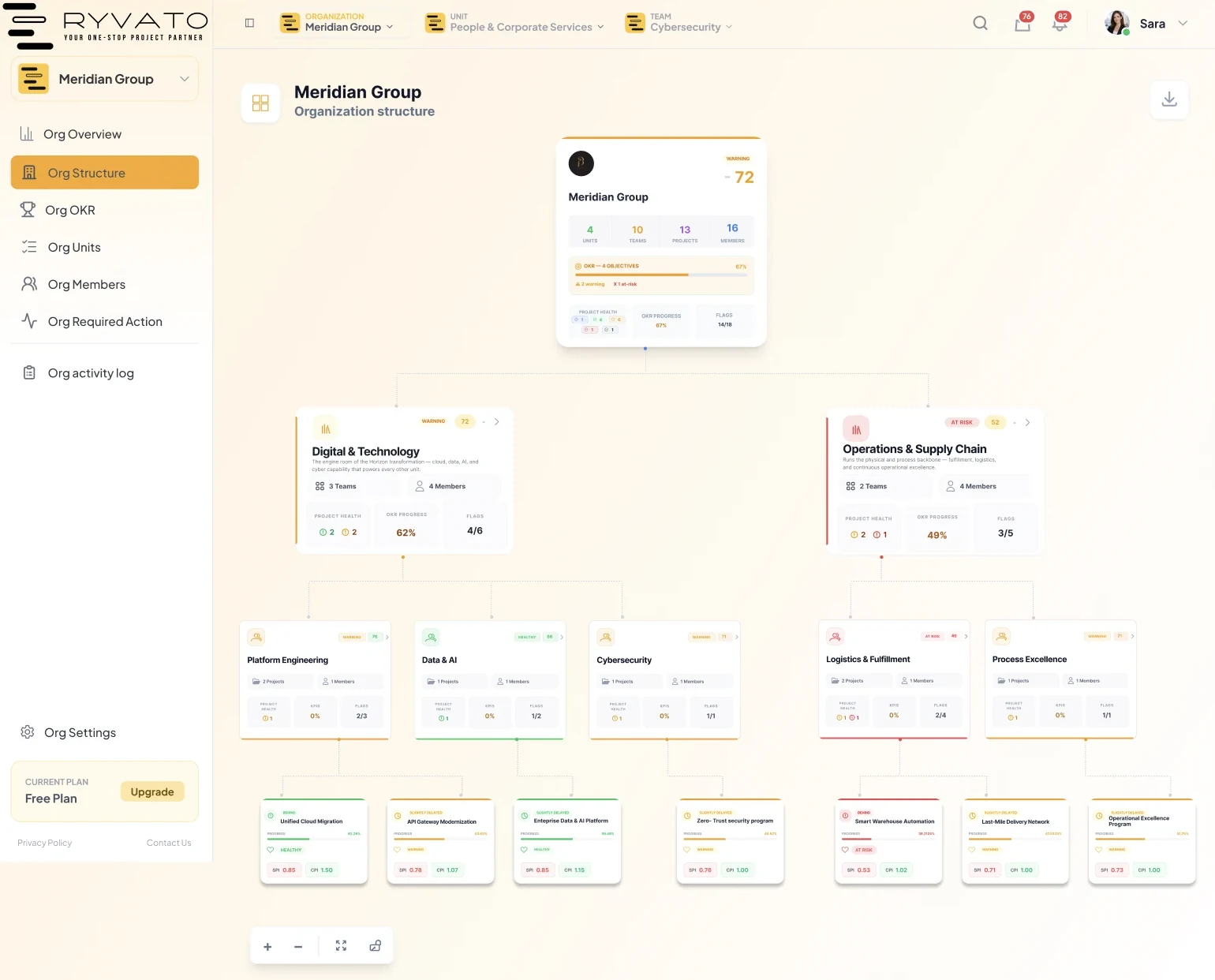
Linking strategy to its objectives and results down to projects and performance indicators, and linking project performance indicators up to the health of portfolios and departments.
Most organisations can write a strategy and most can run a project. The expensive gap is the one in between — where objectives stop being measurable on the way down, and delivery stops being explainable on the way back up. Closing it is not a reporting exercise: it means the same system has to carry the objective, the schedule and what was actually done, at every level.
| Cascading down | Rolling up |
|---|---|
| Objectives | Portfolio health |
| Key results | Earned value |
| KPIs | Schedule performance |
| Projects | Progress and risk |
| Tasks | What was actually done |
Standards and frameworks
What the engines are built to.
PMI PMBOK 7
The project management body of knowledge, with PMI’s practice standards for earned value, scheduling and risk.
ANSI/EIA-748
The earned value management systems standard, and what US federal programme offices are held to.
ISO 21500
Guidance on project management.
ISO 31000
Risk management — guidelines.
ISO 22400
Key performance indicators for automation systems.
PRINCE2
Projects in Controlled Environments — UK Government and AXELOS.
Balanced Scorecard
Kaplan and Norton’s strategy measurement framework.
OKR
Objectives and key results, from Intel and Google.
Shown running
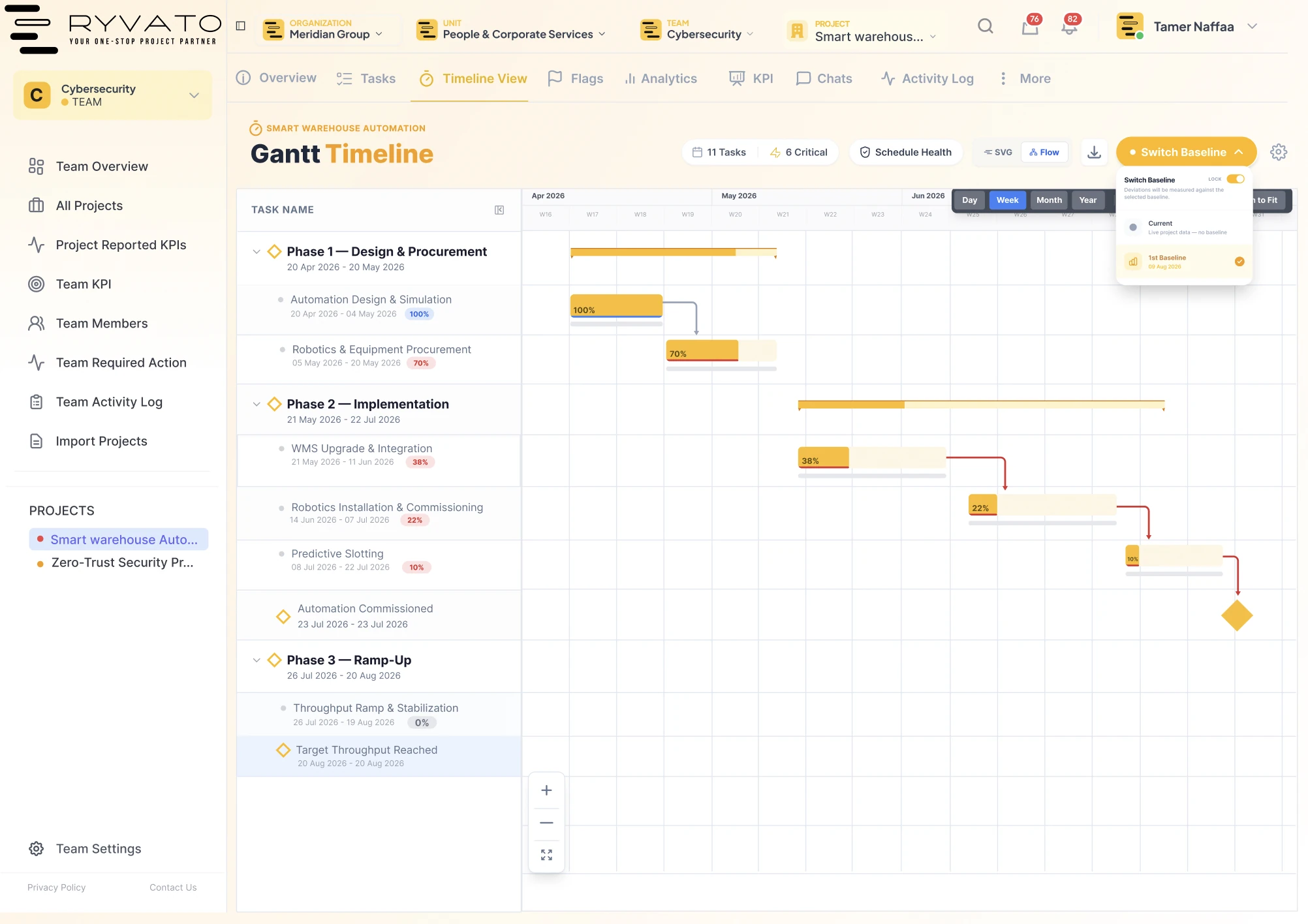
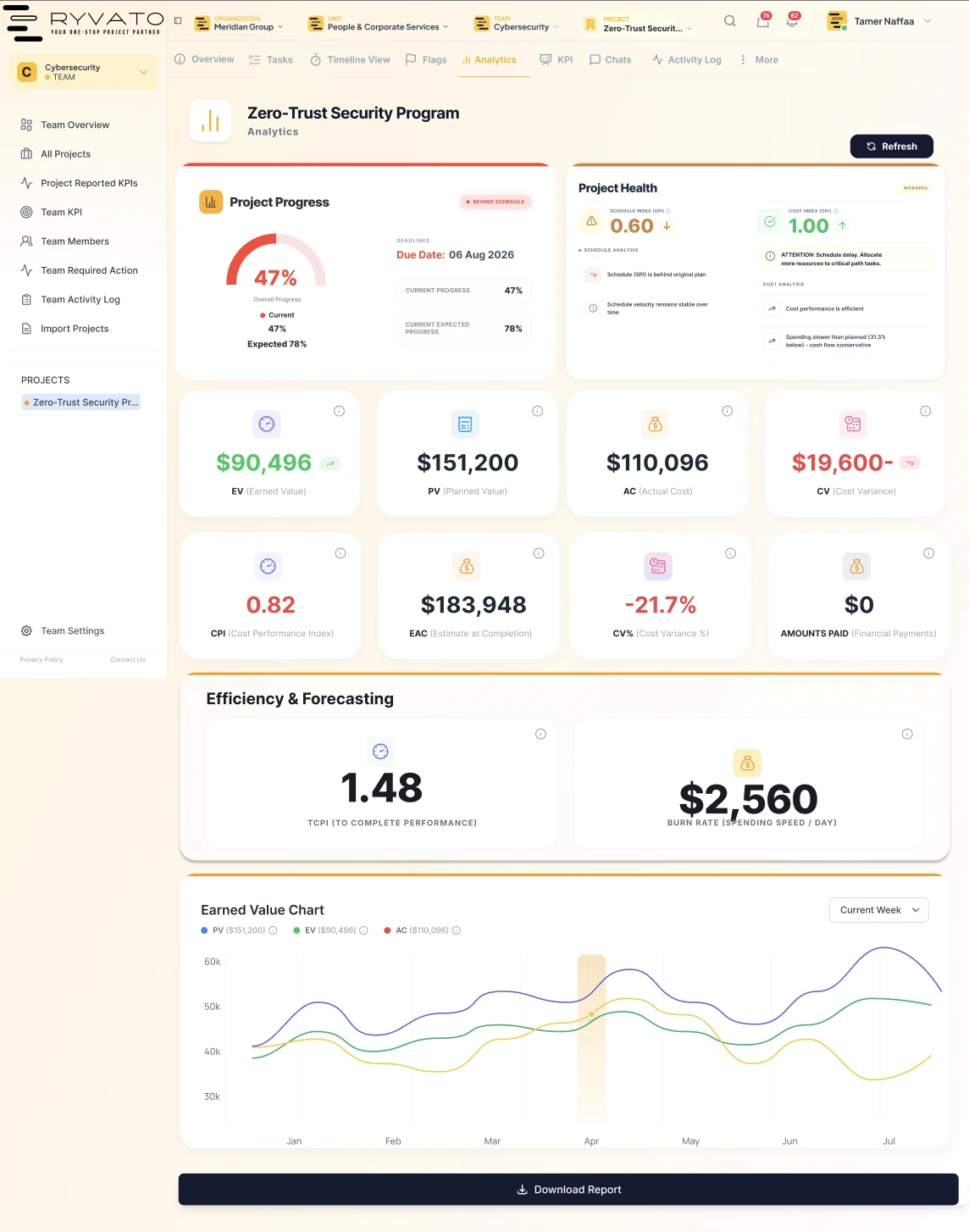
The CPM and EVM engines, running
Ryvato calculates project performance on two engines: the critical path method, and earned value with the schedule and cost calculations that follow from it. These are screens from the running system on sample data — no client's data appears on this page.
Where it runs
Two ways to run Ryvato
- 01
On our hosting, configured for you
Ryvato set up for your organisation — your structure, your KPIs, your workflows — run and kept current by the team that builds it.
- 02
In your own data centre
Ryvato installed and run inside your data centre or your in-Kingdom cloud account, for the data that may not leave the building — scoped and priced on its own.
Do you have processes or administrative work that should be running on a digital platform?
Tell us how the function runs today — or what your people do by hand. We will tell you honestly what it needs: advice on how it should run, a platform, both — or neither. And if it is neither, we will say so.
RYVATO® is a registered trademark, registered in class 9 in the United Arab Emirates and the Kingdom of Saudi Arabia.